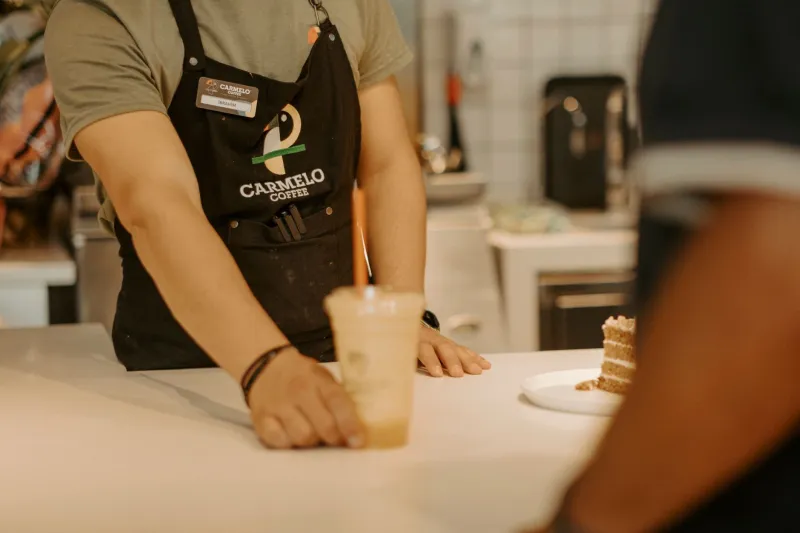
Where Does Your $4.75 Actually Go? We Broke Down Every Nickel Behind the Counter

Every so often, a customer leans on the window ledge, squints at the menu board, and asks the question every coffee stand owner knows is coming: "Four seventy-five? For a cup of coffee?"
We get it. We really do. So instead of giving our usual answer — a smile and a "good beans aren't cheap!" — we decided to do something a little unusual for a ten-foot-wide stand on a neighborhood corner. We broke down, to the penny, where the money from one medium drip actually goes.
The Receipt Behind the Receipt
Let's take a plain 12-ounce drip coffee at $4.75 and follow it backward.
The beans: about $0.55. That sounds low until you learn what it covers. The green coffee we buy from the co-op in Huila, Colombia, costs us roughly $2.85 per pound before it's been shipped, roasted, or bagged. A pound yields about sixteen of our 12-ounce pours once you account for the extra grounds needed for a proper brew. So that fifty-five cents? A chunk of it lands in the hands of the six farming families we profiled in our trip down the bean trail last spring. When coffee prices spike on the commodity market, that number goes up — and we eat some of it rather than pass it all along.
The cup, lid, and sleeve: about $0.38. Paper products have gotten genuinely expensive since 2020. A compostable double-walled cup isn't the same as a styrofoam clone from a warehouse club, and we've made peace with that.
Labor: about $1.30. This is the line item we refuse to shrink. The person handing you that cup is earning a real wage, paid time off, and — starting this year — a health stipend. When folks ask why we can't be fifty cents cheaper, this is usually why.
Rent, utilities, and insurance: about $1.10. Our corner isn't Times Square, but it isn't free either. Water alone, given how much we brew and wash daily, is a quiet budget line nobody thinks about.
Milk, syrups, and the stuff that makes it fun: about $0.35. Even a black coffee carries a share of this, because the cost of stocking the fridge and flavor station gets spread across everything we sell.
Everything else — card fees, repairs, the good music licensing, and yes, a thin margin: about $1.07. Card processing alone eats roughly a dime per transaction. The rest keeps the lights on, fixes the grinder when it dies (it will die), and occasionally lets us sponsor the Little League team down the street.
Why This Matters More Than the Number
Here's the thing we actually want to say: that $4.75 isn't a price, it's a relay. Your money passes through maybe a dozen sets of hands before the transaction is done — a grower in Colombia, a dry-mill worker, a shipping crew, our roaster in Portland, the paper cup factory in Wisconsin, the barista whose name we hope you know by now.
Compare that to the $1.50 gas-station coffee, where the farmer's share often shrinks to pennies and the difference is made up by scale and shortcuts. Neither choice makes you a good or bad person. But when people ask why coffee costs what it costs, the honest answer is: because a lot of people touched it, and most of them aren't getting rich.
The Question We'd Rather You Ask
Instead of "why is this so expensive?" — which is fair! — we'd love it if you asked "who's getting paid here?" It's the same question we ask every time we sign a bean contract. If a cup is cheap because someone along the chain absorbed the cost, that's worth knowing. If it's priced fairly because everyone did their part, that's worth paying for.
And hey — bring your own mug and we'll knock off fifty cents. That's one line item we're happy to hand back to you.